




Strengthening the evidence base for men’s behaviour change programs
8 May 2026
As part of a national project, aimed at strengthening the evidence base for men’s behaviour change programs (MBCPs), we’re pleased to have launched our Theory of Change for MBCPs during a webinar hosted by Relationships Australia.
MBCPs are a key component of Australia’s response to family violence. However, the sector continues to face questions around effectiveness – including when programs work, for whom, and under what conditions. Given the diversity of program models across Australia, developing a shared understanding of how behaviour change occurs is critical to improving both delivery and evaluation.
In 2025, the Relationships Australia (RA) National Research Network initiated a national project, conducted in partnership with the Australian Institute of Family Studies (AIFS), aimed at strengthening the evidence base for MBCPs across the RA federation and sector more broadly.
The first stage of this project involved designing a generalisable Theory of Change for MBCPs, against which we can evaluate programs with different funding models, legislative contexts and program structures.
Following a co-design process involving RA staff, including MBCP facilitators and other staff working in family violence, we identified common aims, activities and mechanisms for change.
We are pleased to present the resulting Theory of Change, which summarises this information in visual form.
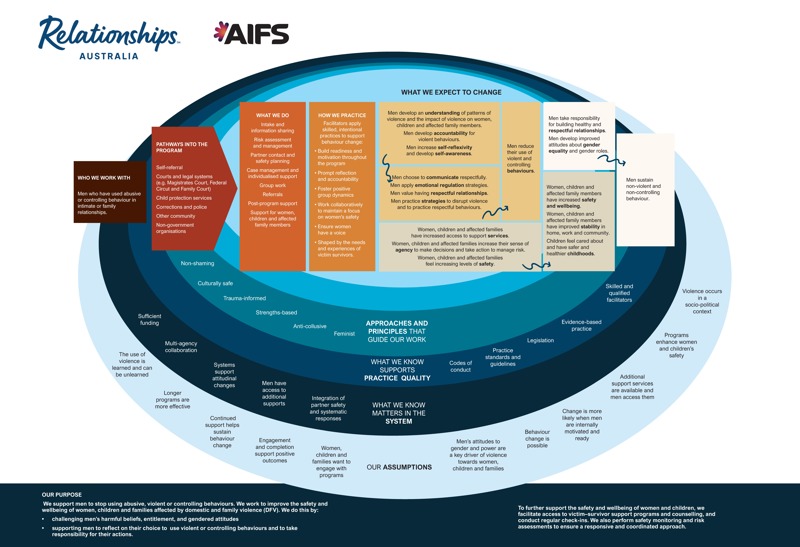
The Theory of Change was launched on 5 May via a webinar hosted by Relationships Australia, with speakers including Dr Genevieve Heard (RA Victoria), Dr Glenn Althor (RA NSW), Sharnee Moore (AIFS) and Stephanie Fisher (AIFS). They discussed the challenges and benefits of this collaborative undertaking, and early work to align an evaluation framework to the Theory of Change.
During the webinar, Dr Heard said that ‘…the challenge for us was to try and develop a common or generalisable Theory of Change which articulates: what are MBCPs at their core, what do they aim to achieve and how do they aim to do that? And we felt that if we could articulate the answers to those questions well, this Theory of Change could be useful not only across the RAs, but within the sector more broadly as we strive to create a stronger evidence base for MBCPs.'
On the importance of the project and work, Sharnee Moore highlighted that ‘…evaluation is all about learning what’s working and what could be better, and it’s our hope that this work can contribute to that understanding and make a real difference to the safety of women and children.’
The next phase of this multi-stage project will involve implementing the evaluation framework across the federation.
We encourage those working and researching in the family violence space to watch the webinar below.